
What will I learn from this chart guide?
This guide separates the chart into positions, signs, houses, and aspects, then walks through one invented position. It teaches you to read the labels; it does not calculate a personal chart or make predictions.
Check the chart header first
Read the chart’s heading before its interpretation. Write down whether it uses a tropical or sidereal zodiac and which house system is selected. Tropical and sidereal charts use different astronomical reference points, not two versions of the same setting. Changing these settings shifts the labels on the chart, which does not mean one website made a math error.
Chart layers, with labels
Zodiac signs and degrees
Numbered houses, divided by the selected house system
Planet and angle positions within those signs and houses
Aspect lines and orb settings
Reading the sample diagram
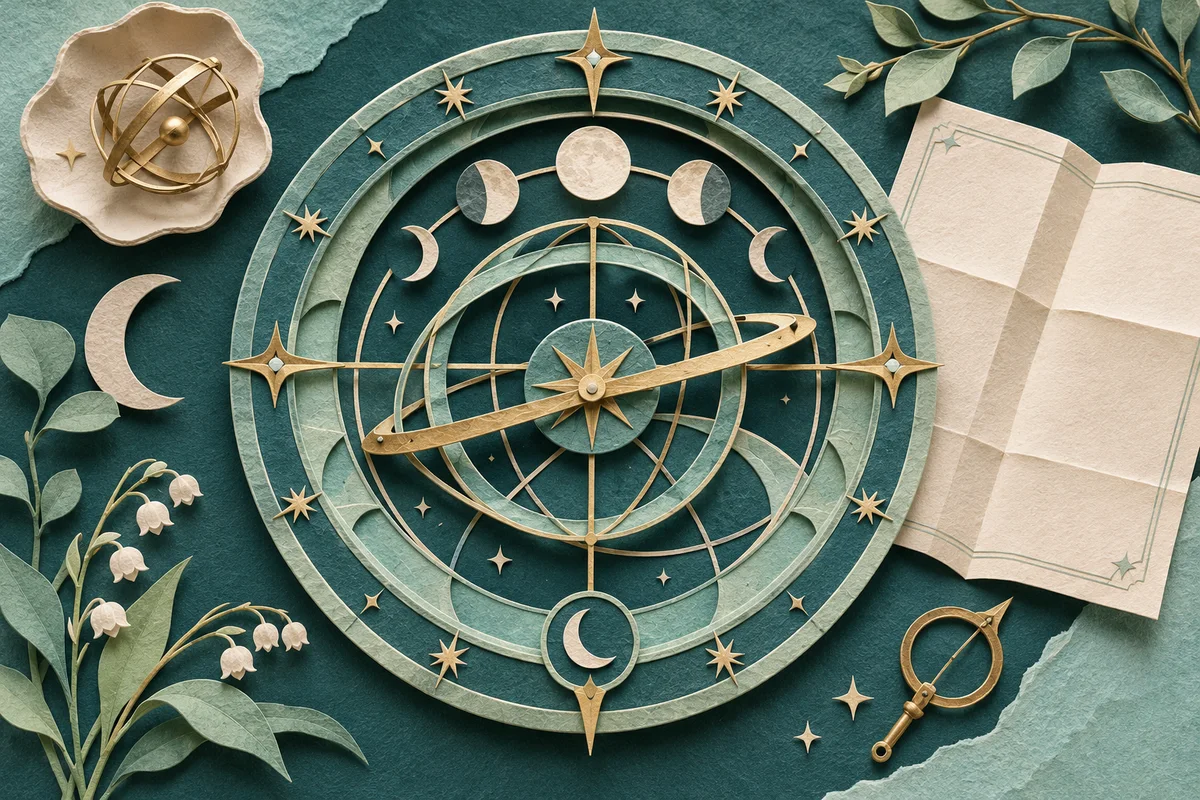
The illustration on this page is a fictional, simplified equal-house diagram created to show chart structure, not a chart calculated from a real birth or ephemeris. In this invented layout, Aries begins the 1st house, and the Moon sits at 15 degrees Taurus in the 2nd house.
Read the same position in three parts: the Moon is the planet, Taurus is the sign, and 2 is the house. “What, how, where” is a useful shorthand for these interpretive layers; it is not a statement of facts about a person.
The wheel shows how placements relate to each other. The table is usually the easier place to check a planet’s exact sign and degree. Read the chart provider’s legend, since colors and line styles vary.
How to read one placement
More columns → Swipe sideways, or focus the table and use the arrow keys.
| Invented chart notation | Read it as | Keep separate |
|---|---|---|
| Venus · Taurus · 10th house | A Venus topic, described through Taurus traits, playing out in 10th-house areas of life | The planet, sign, and house are three separate labels |
| Moon · Gemini · 3rd house | A Moon topic, described through Gemini traits, playing out in 3rd-house areas of life | The Moon sign does not automatically determine the house |
| Mercury · Capricorn · 6th house | A Mercury topic, described through Capricorn traits, playing out in 6th-house areas of life | This placement does not prove a person’s job or skills |
This illustrative learning summary breaks down the relationship between planets, signs, and houses using fictional teaching examples.

- Three separate labels
Read the planet, sign and house as three separate labels. Keep each label visible in your notes.
- Method of Interpretation
Read placements as a thematic topic described by specific traits, manifesting in a particular area of life, such as the 10th-house domain.
- No Automatic Determination
In this example, a Moon sign does not automatically determine the house. Keep the labels separate.

Unknown birth time: what to leave open
Houses and angles depend on the time and place. If a chart is generated with a placeholder time, do not present those outputs as known personal facts. Even a planet’s sign can be uncertain if it crosses a boundary during the available time window. A provider’s unknown-time setting is more honest than silently treating noon as a recorded birth time.
A step-by-step reading checklist
- Confirm the birth data, zodiac type, and house system.
- Find Sun, Moon and Ascendant where the data is reliable.
- Pick one planet and note its sign and house.
- Find one aspect connected to that planet.
- Write down a working interpretation along with one real-life detail that might contradict it.
- Stop there before trying to force a meaning onto every symbol on the page.
Your chart and a friend’s chart website agree on Venus at 15° Taurus, but place it in different houses. What should you check first?
Compare your answer +
Compare the birth time, birth city, and house system on both charts. Matching zodiac degrees do not guarantee matching house divisions. Check the settings before trying to make both house descriptions fit your life.
A complete first-pass chart worksheet
Suppose a friend sends you a chart with a colorful wheel, but the header only lists a birth date and city. First, ask whether the birth time came from a record or a site default. If it is a default time, mark the angles and houses as unverified before reading any descriptions. You can still use the chart to practice reading symbols, as long as you do not treat the house placements as confirmed personal facts.
Next, pick one row from the placement table—for example, Venus at 15° Taurus in the 10th house. Write down all three parts, then find the Venus glyph on the wheel. Checking the table against the wheel prevents a common mistake: misreading a neighboring sign label or house number as your planet’s placement.
Choose one aspect listed for Venus and copy the other point, the aspect name and the orb. Read the provider’s legend to see which aspects it includes. A chart that hides minor aspects is not necessarily claiming those angular relationships do not exist; it may simply display a selected set.
More columns → Swipe sideways, or focus the table and use the arrow keys.
| Your note | Example entry | Status |
|---|---|---|
| Input quality | Birth time entered as noon, not recorded | Uncertain |
| Position copied | Venus at 15° Taurus | As shown by this provider |
| House copied | 10th house | Do not personalize without a reliable birth time. |
| Interpretation | How do my personal values show up in my public role or work? | A question for reflection, not a fixed fact proven by the chart |
Stop once you have a clear question
A beginner does not need to decode every object before asking a thoughtful question. After one placement and one aspect, write what you understand and what you still need to verify. If the interpretation becomes a chain of assumptions, return to the table. Adding more symbols will not repair uncertain input data.
Save the website name, chart settings, and date alongside your notes. If you compare charts across different sites later, change only one setting at a time. That way, you can tell right away whether a difference comes from the birth data, the calculation system, the visual display, or the written interpretation.
Mark what the birth data can support
Verify the stability of chart data before interpreting symbols. This checklist identifies common input risks.
Recorded time
Record where the time came from, then check place, time zone, daylight-saving treatment and chart settings. A recorded time is a useful starting point, not a guarantee that every entered setting is correct.
An approximate window
Compare the possible interval, including transitions within it, not only its endpoints. Mark a sign, house placement or aspect as uncertain if it crosses the relevant boundary. Keep stable fields separate from changing ones.
Unknown time
A noon placeholder is a calculation input, not your established birth time. Set its angles and houses aside. Even planetary signs and aspects need a range check; a date alone does not make every field reliable.
Use three columns in your notes: field, what changes across the possible range, and status. Mark it stable only for that checked range; otherwise write uncertain or set aside. This page does not run those chart calculations.
What if I do not know my birth time?
In the worksheet on this page, mark an uncertain birth time as uncertain. Leave the Ascendant and house entries open instead of filling them with guesses, and keep a note of the input used by the chart provider.
Choose a reading format
Compare conversation styles and purchase terms before choosing a platform.