
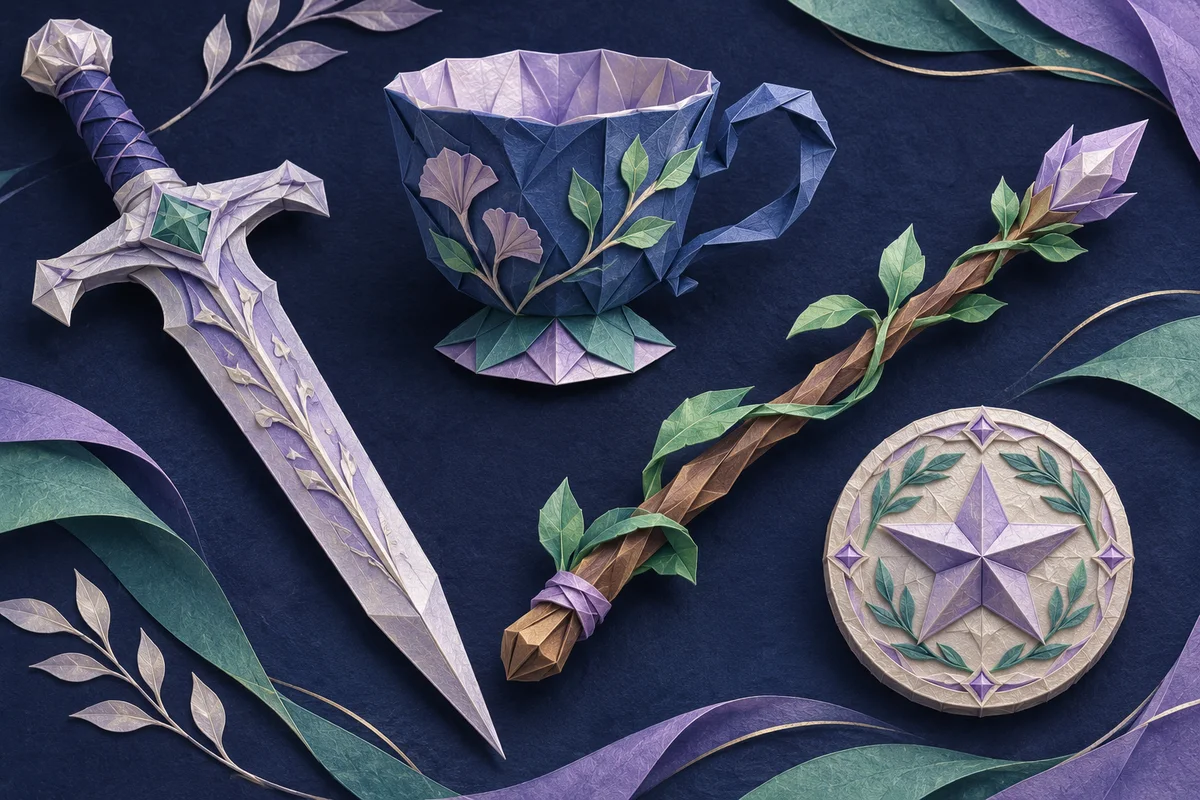
Four suits, four kinds of question
More columns → Swipe sideways, or focus the table and use the arrow keys.
| Suit | Modern study theme | Open the full guide |
|---|---|---|
| Swords | Thought, language & decisions | Study Swords |
| Cups | Feeling, connection & reflection | Study Cups |
| Wands | Intention, effort & creative work | Study Wands |
| Pentacles | Resources, practice & daily conditions | Study Pentacles |
This illustrative learning summary outlines the thematic focus of the four Minor Arcana suits.

- Swords and Cups
Swords involve thought, language, and decisions, while Cups relate to feeling, connection, and reflection within a symbolic reading framework.
- Wands and Pentacles
Wands represent intention, effort, and creative work. Pentacles focus on resources, practice, and the reality of daily conditions.
All 56 cards in one structural index
Read across a row to compare the same rank in all four suits. These brief themes are for study, not prediction. Each suit guide includes a practical exercise for every card.
More columns → Swipe sideways, or focus the table and use the arrow keys.
| Rank | Swords | Cups | Wands | Pentacles |
|---|---|---|---|---|
| Ace | A clear question | An opening to feeling | A creative spark | A practical opportunity |
| Two | Two competing positions | Mutual exchange | Planning a direction | Balancing responsibilities |
| Three | Naming hurt | Shared celebration | Looking beyond the first step | Learning through collaboration |
| Four | A restorative pause | Emotional disengagement | A shared milestone | Holding resources closely |
| Five | A costly argument | Attention to loss | Competing efforts | A lack of practical support |
| Six | Moving toward a different perspective | Remembering a connection | Recognition of work | Giving and receiving |
| Seven | An indirect approach | Several imagined possibilities | Defending a position | Reviewing what an effort yields |
| Eight | A perceived restriction | Leaving an unsatisfying pattern | Rapid movement | Repeated practice |
| Nine | A recurring worry | Personal satisfaction | Persistence under strain | Enjoying cultivated independence |
| Ten | An exhausted approach | A picture of belonging | Too much to carry | Continuity and shared resources |
| Page | Curiosity and questions | An emotional invitation | Exploring an idea | A practical learning goal |
| Knight | Quick intellectual action | An expressive gesture | An energetic start | Steady follow-through |
| Queen | A discerning boundary | Receptive attention | Confident participation | Caring for everyday conditions |
| King | A considered judgement | Steady emotional presence | Directing a creative effort | Responsible stewardship |
Why the same number changes across suits
More columns → Swipe sideways, or focus the table and use the arrow keys.
| Three of… | Example question | Real-life evidence to check |
|---|---|---|
| Swords | What hurt needs to be named clearly? | The words or event that occurred |
| Cups | Who is part of this shared moment? | Actual participation and consent |
| Wands | What is needed beyond the first step? | A practical next-stage requirement |
| Pentacles | What feedback would improve this work? | A specific skill or contribution |
Reading court cards as roles and actions
You can read a Page as learning, a Knight as pursuing, a Queen as sustaining, and a King as directing. Use this as a study lens rather than a rule about someone’s gender, age, or social status. Look for the action in the situation before matching the card to a person.
More columns → Swipe sideways, or focus the table and use the arrow keys.
| Role exercise | A fictional community project |
|---|---|
| Page | Ask how the equipment works before using it |
| Knight | Take the first agreed task forward |
| Queen | Make the working conditions supportive |
| King | Clarify responsibilities and the decision process |
How spread positions shape a theme
In an Action position, the Eight of Pentacles can point to deliberate practice. In an Obstacle position, it might ask if you are polishing one detail to avoid feedback. A spread position changes the question you ask, not the facts of your situation; the card itself is not proof that either scenario is happening.
Choose three position labels