

Mixing your deck
Learning how to shuffle tarot cards involves finding a physical method that protects your deck while creating a random order. There is no standard number of times you must shuffle, nor is there a ritual requirement for cleansing the cards. You may stop whenever the cards feel sufficiently mixed for your needs.
Preparation and handling
Before you begin, clear a flat surface to provide enough room for the deck. Handle the cards gently to avoid bending or fraying the edges. If you wish to include reversed meanings in your practice, mix the deck thoroughly in both directions so that some cards end up upside down.
Decide on your convention before you start. If you prefer to interpret only upright cards, keep them all facing the same direction as you mix. Clarifying your question or intent beforehand helps you focus during the physical process.
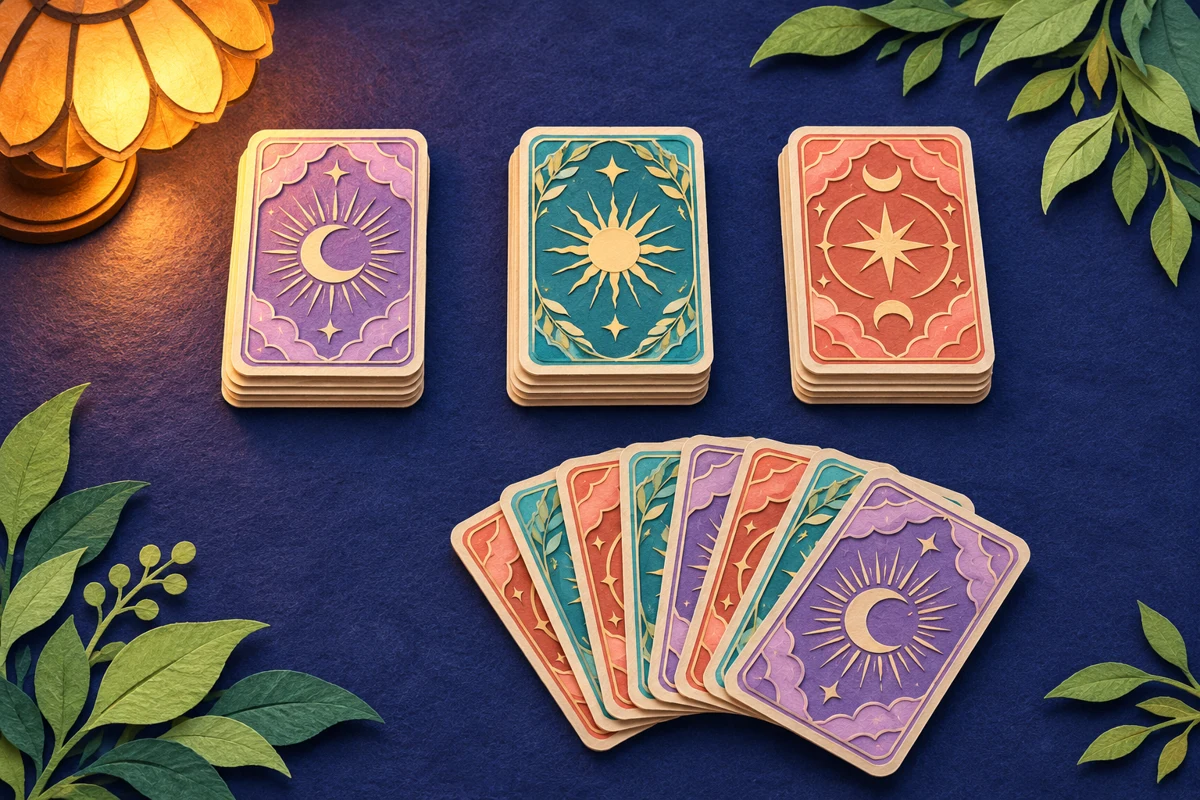

The overhand shuffle
To perform an overhand shuffle, hold the full deck in one hand, typically your non-dominant hand. Use your other hand to lift a small packet of cards from the center or back of the deck.
Drop the packet into your receiving palm, then transfer another small packet onto it. Continue until the deck has passed through your hands, and square the edges gently. Repeat as desired without bending the cards.
Mix · cut · place
Keep the deck facing one way if you want upright-only readings.
Move small packets, or mix on the table. Stop when you choose.
Name each position before placing the cards from left to right.
Table mixing
If a full deck feels awkward to hold, use a table wash. Spread the cards face down on a flat surface and move them around with your hands in a circular, disorganized motion. This method is effective for larger decks or when you want to avoid mechanical stress on the card stock.
Once the cards are well-scrambled on the table, push them back together into a single pile. You can then square the edges by tapping the stack against the table surface to tidy the formation.
Another option is to mix half the deck at a time, then combine the halves. For a one-handed approach, leave the cards face down on the table and move them gently around before gathering them. Choose a clean surface and avoid dragging cards over rough edges.
Cutting the deck
Cutting is an optional step that can follow your shuffling. Simply divide the deck into two or three smaller piles on the table. Reassemble the piles in a different order than they were taken from, such as placing the original bottom pile on top.
Managing reversals
Reversals occur when a card appears upside down in the spread. If you choose to use reversals, ensure the cards are rotated during the shuffle so that the orientation is randomized. If you prefer a simpler reading, use the digital tool to draw only upright cards, as it does not simulate the physical chance of reversal.
Practice example
For an example exercise, place your deck on a table and divide it into four small piles. Swap the positions of these piles randomly before pulling them back into a single deck. If a card drops on the floor during this process, simply pick it up and return it to the deck; we do not treat a dropped card as a message.
Common questions
How many shuffles are enough? There is no ritual count required in this guide; mix the cards, then stop when you are ready. Cutting afterwards is optional.
Is a reversed card bad? No automatic good-or-bad rule is used here. Decide whether to include reversals before drawing. If a card falls, simply return it to the deck for this exercise.
Next steps
Note that the digital tool provides a draw, not a physical shuffle. When working with your own cards, keep a journal of your observations regarding the cards you draw. You can continue with our guides on card meanings or basic spread layouts to expand your practice.