
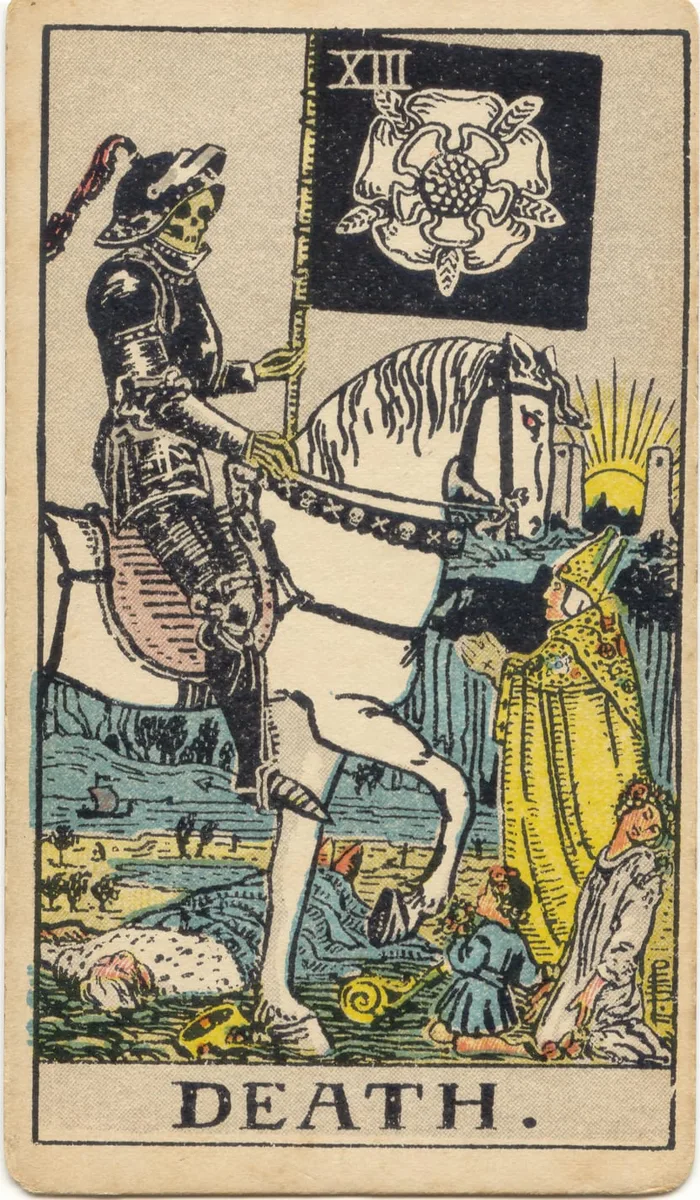
 Death
Understanding Endings
Identify what is ending and what needs a deliberate transition.
Card imagery and meaning
The Death card depicts a skeleton riding a white horse through a field. Figures on foot stand before it.
The image is a scan of the original 1909 deck illustrated by Pamela Colman Smith. Separate what you can observe in the drawing from the interpretation you bring to it. The questions below are modern reflection exercises.
Upright and reversed meanings
The reversed meanings below are modern reflection prompts rather than a single traditional rule. Our card-drawing tool uses upright cards only.
More columns → Swipe sideways, or focus the table and use the arrow keys.
| Orientation | A useful lens | Before you interpret |
|---|---|---|
| Upright | Identify what is ending and what needs a deliberate transition. | Does this question match the facts of your situation? |
| Reversed | See if you're resisting a needed change or trying to drop something before you understand it. | Look for too much of this quality, too little of it, or a different angle. Do not simply flip the upright meaning into its opposite. |
Look closer at the card

Card imagery and meaning
The Death card depicts a skeleton riding a white horse through a field. Figures on foot stand before it.

Read the spread position alongside the card
More columns → Swipe sideways, or focus the table and use the arrow keys.
| Position | Question to explore | What to record alongside it |
|---|---|---|
| Situation | Identify what is ending and determine what resources remain available to you. | Write down the specific fact or event that prompted your question. |
| Obstacle | Assess if the concept of an ending is too central, ignored, or irrelevant to your current situation. | Several interpretations may fit, or none at all. |
| Action | A contract or professional role finishing does not remove the skills or experience you gained. | Pick a low-risk action you can undo, and watch what happens. |
| Reflection | Track how your perspective on what counts as an ending has shifted. | Compare your original notes with what actually happened. |
Practice scenario
Fictional situation: For example: A contract ends and the daily structure of your week changes.
Try this: List the elements that are ending, the skills you retain, and the practical details requiring attention. Pick one specific, manageable next step.
Check the interpretation: Ask: “What is ending, and what can I carry forward?” If the theme does not apply, disregard it. You are not required to force a connection for every card.
This is a fictional exercise for working with the Death card.
- Identify ending elements
List the specific roles, contracts, or daily structures that are coming to a conclusion to understand what space is opening up for you.
- Retain useful skills
Focus on the experience and practical skills you have gained that remain with you after a formal arrangement or phase has finished.
- Take manageable action
Address the practical details by selecting one specific and manageable next step rather than attempting to resolve every loose end at once.
Relationships and work
Relationships: This card does not predict literal death, health diagnoses, or the inevitable end of a specific relationship.
Work and practice: A contract or professional role finishing does not remove the skills or experience you gained.
Comparing Death and The World
An ending necessitates transition, while reaching completion requires reflection.
Read The WorldQuick exercise
Write one sentence stating the facts of your situation. Answer: “What is ending, and what can I carry forward?” Underline any part of your answer that is an assumption instead of a fact.
See an example of fact vs. assumption +
“The deadline changed” is an observation. “This means my work is not valued” is an interpretation. That thought might be worth discussing, but a tarot card cannot prove it is true.