
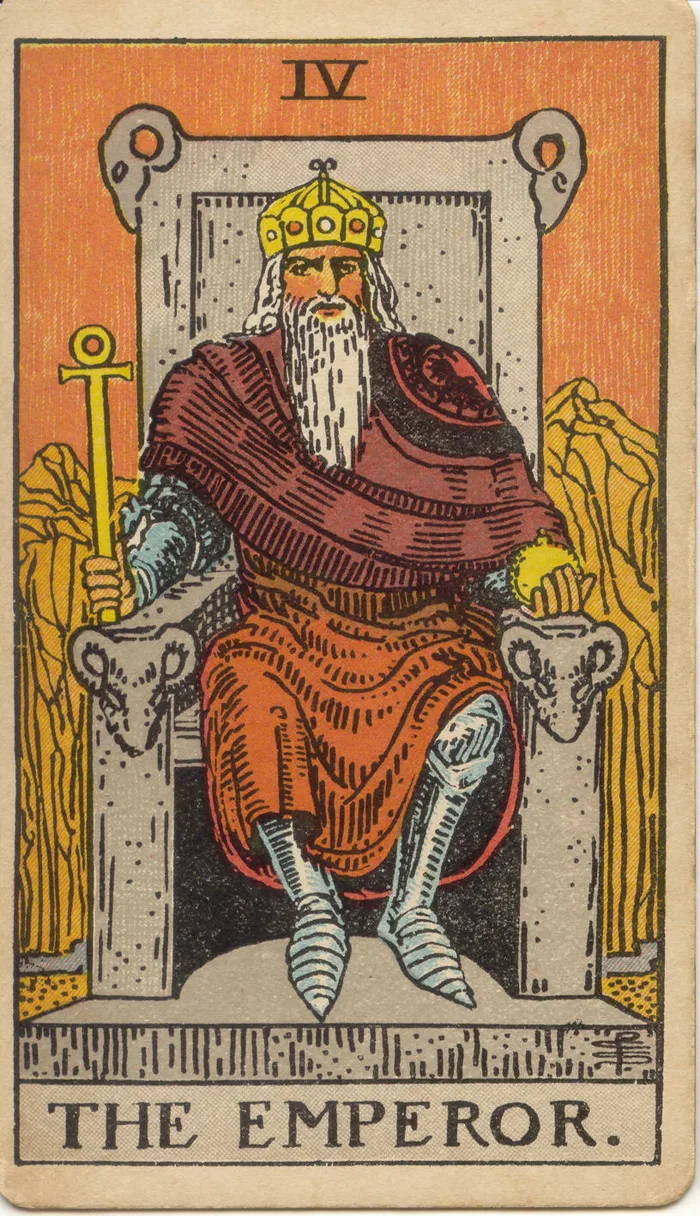
 The Emperor
Structure in Context
Make responsibilities, agreements and limits easier to see.
Card imagery and meaning
An armored figure sits on a solid throne decorated with ram imagery.
The image is a scan of the original 1909 deck illustrated by Pamela Colman Smith. Separate what you can observe in the drawing from the interpretation you bring to it. The questions below are modern reflection exercises.
Upright and reversed meanings
The reversed meanings below are modern reflection prompts rather than a single traditional rule. Our card-drawing tool uses upright cards only.
More columns → Swipe sideways, or focus the table and use the arrow keys.
| Orientation | A useful lens | Before you interpret |
|---|---|---|
| Upright | Make responsibilities, agreements and limits easier to see. | Does this question match the facts of your situation? |
| Reversed | See if structure has turned into rigid control, or if a lack of boundaries makes a task harder. | Look for too much of this quality, too little of it, or a different angle. Do not simply flip the upright meaning into its opposite. |
Look closer at the card

Card imagery and meaning
An armored figure sits on a solid throne decorated with ram imagery.

Read the spread position alongside the card
More columns → Swipe sideways, or focus the table and use the arrow keys.
| Position | Question to explore | What to record alongside it |
|---|---|---|
| Situation | Which agreement would reduce confusion? | Write down the specific fact or event that prompted your question. |
| Obstacle | Could the theme of structure be overemphasized, neglected, or simply irrelevant? | Several interpretations may fit, or none at all. |
| Action | A useful rule clarifies responsibility and can be reviewed when conditions change. | Pick a low-risk action you can undo, and watch what happens. |
| Reflection | How did your understanding of structure change? | Compare your original notes with what actually happened. |
Practice scenario
Fictional situation: A small team keeps duplicating work and missing handoffs.
Try this: Write down one owner and one completion condition for each task, then ask the people doing the work for corrections.
Check the interpretation: Ask which agreement would reduce confusion. If this theme does not fit your situation, set it aside. You do not need to force every drawn card into an explanation.
A fictional exercise for applying structural clarity.
- Identify task ownership
Assign one specific owner and one completion condition for each task to resolve duplication and missing handoffs within your team.
- Verify with collaborators
Ask the people doing the work for corrections. Which agreement could reduce confusion?
Relationships and work
Relationships: Agree on boundaries together rather than imposing them as a test of loyalty.
Work and practice: A useful rule clarifies responsibility and can be reviewed when conditions change.
Compare The Emperor with Justice
Structure assigns roles; fairness asks whether the roles and consequences are appropriate.
Read JusticeQuick exercise
Write one sentence describing the facts of your situation. Then answer: “Which agreement would reduce confusion?” Underline anything in your answer that is an inference rather than an observation.
See an example of fact vs. assumption +
“The deadline changed” is an observation. “This means my work is not valued” is an interpretation. That thought might be worth discussing, but a tarot card cannot prove it is true.