
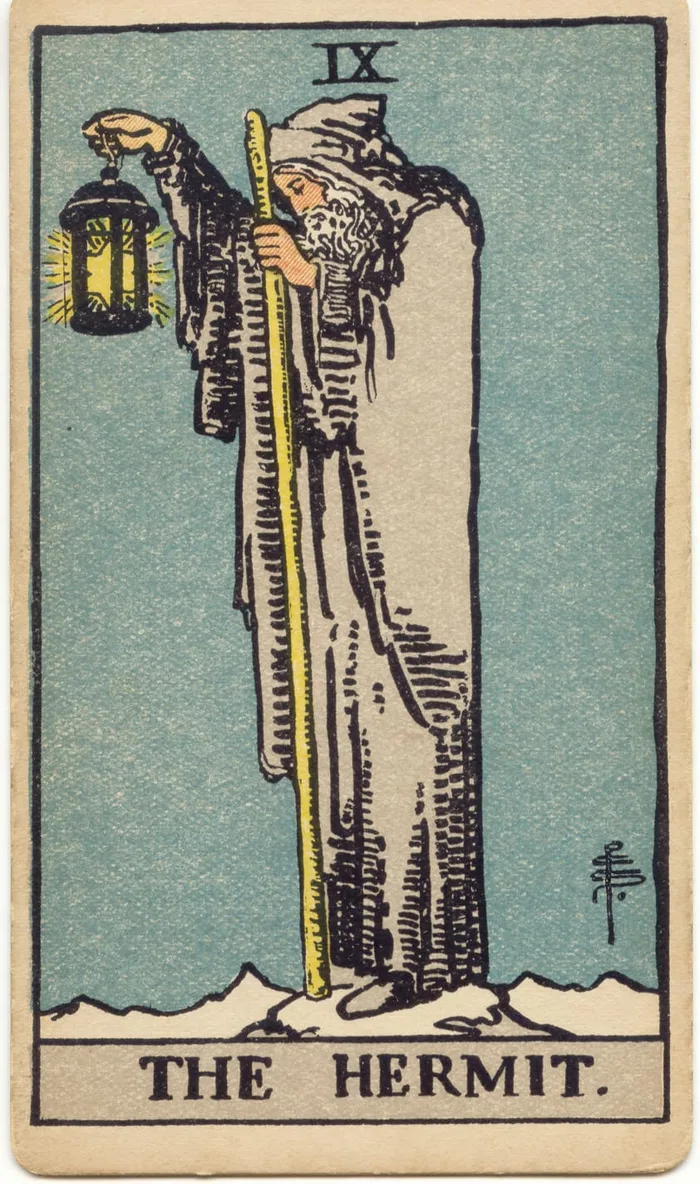
 The Hermit
Solitude in Context
Create a bounded period for reflection, study or careful observation.
Card imagery and meaning
A cloaked figure holds a raised lantern and a staff.
The image is a scan of the original 1909 deck illustrated by Pamela Colman Smith. Separate what you can observe in the drawing from the interpretation you bring to it. The questions below are modern reflection exercises.
Upright and reversed meanings
The reversed meanings below are modern reflection prompts rather than a single traditional rule. Our card-drawing tool uses upright cards only.
More columns → Swipe sideways, or focus the table and use the arrow keys.
| Orientation | A useful lens | Before you interpret |
|---|---|---|
| Upright | Create a bounded period for reflection, study or careful observation. | Does this question match the facts of your situation? |
| Reversed | Consider whether time alone is useful or whether you need a conversation and support. | Look for too much of this quality, too little of it, or a different angle. Do not simply flip the upright meaning into its opposite. |
Look closer at the card

Card imagery and meaning
A cloaked figure holds a raised lantern and a staff.

Read the spread position alongside the card
More columns → Swipe sideways, or focus the table and use the arrow keys.
| Position | Question to explore | What to record alongside it |
|---|---|---|
| Situation | What question deserves quiet attention? | Write down the specific fact or event that prompted your question. |
| Obstacle | Could the theme of solitude be overemphasized, neglected, or simply irrelevant? | Several interpretations may fit, or none at all. |
| Action | Focused study works best when you start with a clear question and a way to test your answer. | Pick a low-risk action you can undo, and watch what happens. |
| Reflection | How did your view of solitude change? | Compare your original notes with what actually happened. |
Practice scenario
Fictional situation: You want to step back from a busy group to think through a decision.
Try this: Set an end time for reflection. Write down one question, gather the relevant facts, and decide whom to consult afterward.
Check the interpretation: What question deserves quiet attention? If that theme does not fit your situation, set it aside. You do not need to force every drawn card into an explanation.
An illustrative learning summary for the Hermit card in a fictional exercise.
- Define the scope
Set an end time for your reflection and write down one specific question you need to consider in quiet.
- Prepare and consult
Gather the relevant facts for your chosen question and decide which individuals you will consult after your reflection period.
- Evaluate the relevance
Check if the theme fits your current situation; if it does not, you may set the card aside without force.
Relationships and work
Relationships: State your need for space clearly instead of expecting the other person to guess.
Work and practice: Focused study works best when you start with a clear question and a way to test your answer.
Compare The Hermit with The Hierophant
Shared knowledge can sharpen private reflection.
Read The HierophantQuick exercise
Write one sentence stating the facts of your situation. Then answer: “What question deserves quiet attention?” Underline any part of your answer that is an inference rather than a direct observation.
See an example of fact vs. assumption +
“The deadline changed” is an observation. “This means my work is not valued” is an interpretation. That thought might be worth discussing, but a tarot card cannot prove it is true.