
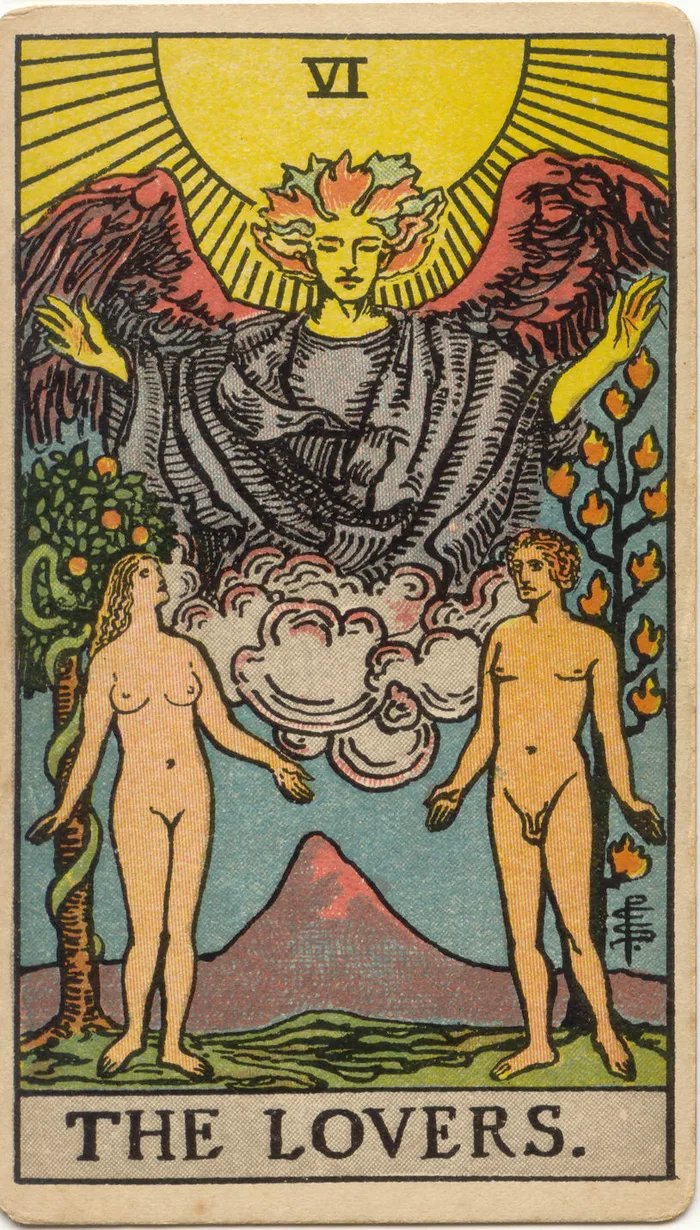
 The Lovers
Values, in context.
Bring a choice into conversation with your values and with the people it affects.
Card imagery and meaning
Two figures stand beneath an angel, with a tree behind each of them.
The image is a scan of the original 1909 deck illustrated by Pamela Colman Smith. Separate what you can observe in the drawing from the interpretation you bring to it. The questions below are modern reflection exercises.
Upright and reversed meanings
The reversed meanings below are modern reflection prompts rather than a single traditional rule. Our card-drawing tool uses upright cards only.
More columns → Swipe sideways, or focus the table and use the arrow keys.
| Orientation | A useful lens | Before you interpret |
|---|---|---|
| Upright | Bring a choice into conversation with your values and with the people it affects. | Does this question match the facts of your situation? |
| Reversed | Look for an unresolved mismatch between what you say matters and what an option requires. | Look for too much of this quality, too little of it, or a different angle. Do not simply flip the upright meaning into its opposite. |
Look closer at the card

Card imagery and meaning
Two figures stand beneath an angel, with a tree behind each of them.

Read the spread position alongside the card
More columns → Swipe sideways, or focus the table and use the arrow keys.
| Position | Question to explore | What to record alongside it |
|---|---|---|
| Situation | What would make my choice consistent with my values? | Write down the specific fact or event that prompted your question. |
| Obstacle | Could the theme of values be overemphasised, neglected or simply irrelevant? | Several interpretations may fit, or none at all. |
| Action | Choose using the actual trade-offs rather than a promise of a perfect fit. | Pick a low-risk action you can undo, and watch what happens. |
| Reflection | How did your understanding of values change? | Compare your original notes with what actually happened. |
Practice scenario
Fictional situation: Two possible living arrangements offer different kinds of freedom and responsibility.
Try this: List your three non-negotiables and test each option against what you can actually observe. Then talk with everyone who shares the decision.
Check the interpretation: What would align this choice with my values? If that question doesn't fit your situation, set it aside. You don't have to force every drawn card into an explanation.
An illustrative learning summary of decision-making practices for The Lovers card in a fictional scenario.
- Identify core constraints
List three non-negotiables for the situation. Test each housing option against concrete, observable facts rather than relying on abstract preferences alone.
- Talk it through
Talk with everyone who shares the decision about the freedom and responsibility each option involves.
- Evaluate value alignment
Ask if a choice aligns with your personal values. If this inquiry does not suit your specific circumstances, you may set it aside.
Relationships and work
Relationships: A relationship card does not establish mutual attraction, commitment or a destined partner.
Work and practice: Choose using the actual trade-offs rather than a promise of a perfect fit.
Compare The Lovers with Justice
Values guide a choice; consequences and agreements test it in practice.
Read JusticeQuick exercise
State the facts of your situation in one sentence. Next, answer this question: “What would make my choice consistent with my values?” In your answer, underline any guesswork rather than what you have directly observed.
See an example of fact vs. assumption +
“The deadline changed” is an observation. “This means my work is not valued” is an interpretation. That thought might be worth discussing, but a tarot card cannot prove it is true.